

How to Design Custom Youth Uniforms for Your Team
Last Updated: October 26, 2026
Quick Summary
To design custom youth uniforms, pick a sport-specific style, sketch your design ideas, and build a proof with an online jersey design tool. Then measure every player against a youth sizing guide, budget the full per-player cost, and approve the final proof before ordering.
- Baseball and softball uniforms need a jersey, pants, and cap, while soccer and basketball use jerseys and shorts.
- Measure chest, waist, height, and inseam over a t-shirt, then compare each number to the vendor's chart separately.
- Sublimated printing holds up better than heat-applied logos, which can crack and peel after repeated washing.
- Add one-time artwork, setup, and shipping costs to the per-player pieces to find the true per-player share.
- Before approving the proof, check every name spelling, duplicate numbers, colors, logo sharpness, and sizes.
Table of Contents
- Step 1: Pick Your Sport-Specific Uniform Style
- Step 2: Bring Your Custom Team Jersey Design Ideas to Life
- Step 3: Use an Online Jersey Design Tool to Build the Proof
- Step 4: Follow a Youth Uniform Sizing Guide Before You Order
- Step 5: Choose Durable Custom Jerseys for Youth Athletes
- Step 6: Budget the Whole Team Order, Not Just the Jersey
- Step 7: Collect Player Info and Approve the Final Proof
- Customize Your Team Gear with Game Day Tampa Bay
- Frequently Asked Questions
Step 1: Pick Your Sport-Specific Uniform Style
Designing custom youth uniforms starts with one decision: what does your sport actually require? A baseball uniform looks nothing like a soccer jersey, and getting this wrong means a season of uncomfortable kids.
Here's the practical breakdown:
- Baseball and softball: jersey, pants, and cap. Button fronts help, and pants need room to slide.
- Soccer: jersey and shorts. Sleeveless or short-sleeve cuts keep players cool.
- Basketball: jersey and shorts, usually sleeveless for arm movement.
The National Federation of State High School Associations rulebook sets baseline uniform rules for school-age play. Check your league's own handbook too, since local rec leagues often add their own color and number rules.
Step 2: Bring Your Custom Team Jersey Design Ideas to Life
Most teams copy last year's look and call it a design. Don't. Sketch your ideas first, even badly.
Grab a notebook and rough out three things: the front, the back, and the sleeve. Then ask your players what they want. Kids care more about the design than parents expect, and a team that likes its gear plays with more pride.
A few starting points that work for youth teams:
- One strong color plus a neutral, not five colors fighting each other
- A large team name across the chest
- A simple mascot or symbol that reads from across a field
If you want a head start, our Dri Fit Short Sleeves Tee Design C gives you a customizable base to react to. It's easier to edit a real design than to invent one from nothing.

Step 3: Use an Online Jersey Design Tool to Build the Proof
An online jersey design tool lets you build the full uniform on screen and see a design preview before anything is printed. That preview is the whole point: you catch mistakes on a screen, not on forty finished jerseys.
Most tools walk you through the same steps:
- Pick your uniform set (jersey, shorts, pants, caps)
- Choose team colors from a color scheme picker
- Upload your team logo and custom artwork
- Add player names and jersey numbers
- Check number placement on the front, back, and sleeves
Colors, Logos, Names, and Numbers
Two rules save teams from ugly results. First, check that your team colors are actually distinct from your league rivals. Second, upload the highest-resolution logo file you have, because a blurry logo looks worse on fabric than it does on a screen.
For player names, spell every one correctly. We've seen more reprints caused by a misspelled name than by any other mistake. Read them out loud, letter by letter, before you approve.
Step 4: Follow a Youth Uniform Sizing Guide Before You Order
A youth uniform sizing guide is a chart that matches body measurements to jersey sizes, and it matters more than any other step. Kids grow mid-season. A jersey that fits in August can look like a crop top by October.
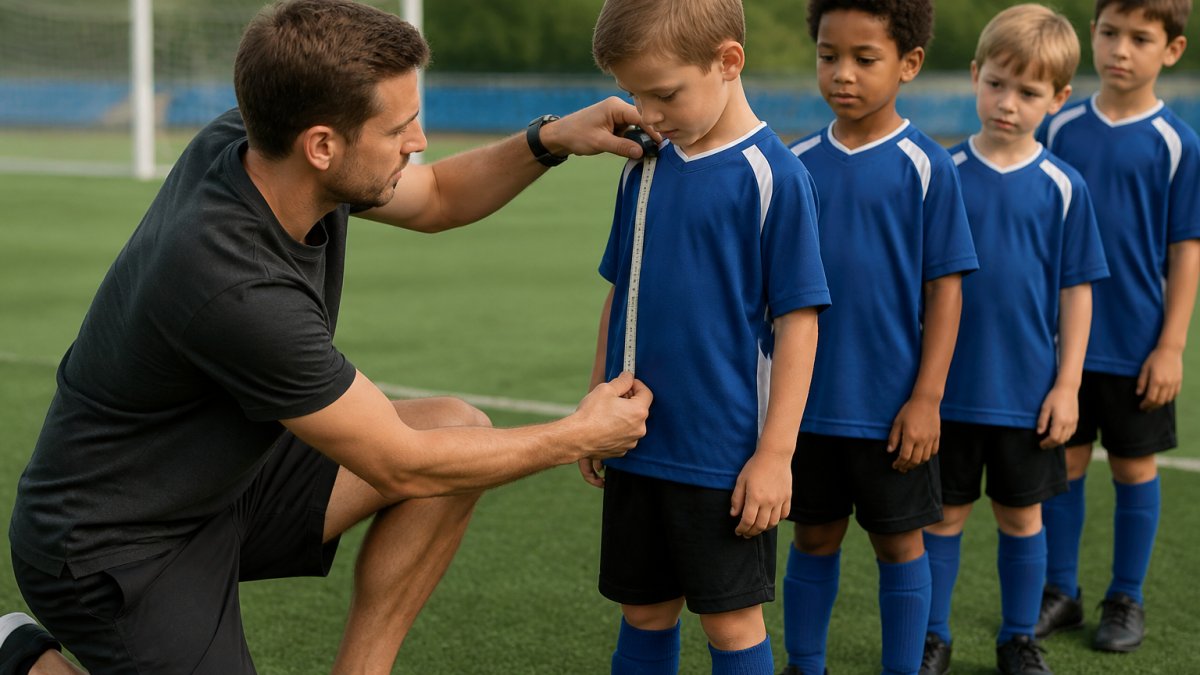
How to Measure a Young Athlete
Measure over a t-shirt, not over a jacket, and keep the tape snug but not tight. You need four numbers per player:
- Chest: around the fullest part of the chest, tape level under the arms
- Waist: at the natural waistline, usually just above the hip bones
- Height: standing against a wall, no shoes
Write the numbers down per player, don't round to the nearest size yet. Compare each set against the vendor's chart and note where the player lands on chest, waist, and height separately. A player can be a Youth Medium in the chest and a Youth Large in height, and that mismatch is exactly where sizing errors start.
Handling Players Between Sizes
A common pattern among youth coaches is to size up when a player sits at the top of a range or is close to a growth spurt. The trade-off is real: a jersey one size up has room to grow but can look baggy and can bunch under protective gear. For basketball and soccer, where fit affects movement, stay closer to true size.
Pro Tip
Ask parents whether the player has grown since the last uniform order. A player who jumped a size last season will likely jump again. If two players on the roster are the same age but very different builds, size each one individually rather than ordering a single team size.
Account for Protective Gear
Measure players in the gear they'll actually wear. Football shoulder pads add width across the chest and shoulders; a jersey sized without pads will be too tight. Baseball and softball pants need enough room in the seat and thighs to slide without binding. Lacrosse and hockey players should be measured with shoulder and elbow pads on. If you can't measure in gear, ask the vendor how much ease their size chart already builds in for pads.
Don't Let Parents Self-Report Sizes
"Medium" means something different at every brand, and that gap is where most sizing headaches start. Send parents the vendor's actual size chart and the four measurements to collect, and have them measure at home with a tape. If a parent can't measure, have them bring the player to a team sizing day. A shared spreadsheet with columns for name, chest, waist, height, inseam, and requested size keeps the roster in one place and makes the final order review much faster.
Dri Fit Short Sleeves Tee Design C →
Request Samples for Wide Body-Type Spreads
If your roster ranges from slender to stocky, ask the vendor about sample jerseys in two or three youth sizes. Having players try on a sample before the full order is the cheapest way to catch a bad size chart. Many vendors will loan samples or sell single pieces at a sample price; ask before you assume.
Step 5: Choose Durable Custom Jerseys for Youth Athletes
Durable custom jerseys for youth athletes need three things: strong seams, colorfast fabric, and printing that survives repeated washing. Kids are hard on gear. A jersey that peels after three games is money wasted.
Ask these questions before you order:
- Is the printing sublimated (dyed into the fabric) or applied on top?
- Are the seams double-stitched at stress points?
- What does the care label say about washing?
Sublimated designs hold up better than heat-applied logos, which can crack and peel. If durability is your main worry, our guide to durable custom jerseys for youth athletes goes deeper on fabrics and construction.
Step 6: Budget the Whole Team Order, Not Just the Jersey
The jersey price is never the full cost. Budget the uniform set: jersey, shorts or pants, caps, plus names and numbers if they're priced separately. Then add shipping. A youth league budget usually has less slack than a school or club budget, so build the full per-player number before you collect a single dollar from parents.
Build a Per-Player Cost Sheet
Start with the base price for each piece and multiply by the roster size. Then layer in the add-ons that vendors often price separately.
| Cost Item | What to Check | Why It Matters |
|---|---|---|
| Jersey | Base price per player | The starting number |
| Shorts or pants | Sold separately? | Often the surprise cost |
| Caps or socks | Included or add-on? | Easy to forget in the set |
| Names and numbers | Included or add-on? | Adds up across a roster |
| Artwork or setup fee | One-time or per design? | Hits the team, not the player |
| Minimum quantity | Does the vendor require a minimum? | Small rosters pay more per piece |
| Shipping | Flat or per item? | Changes the final total |
| Replacements | Cost of a reorder | Late roster adds happen |
Add the per-player pieces together, multiply by the number of players, then add the one-time costs (artwork, setup, shipping) and divide by the roster to see the true per-player share. That number, not the jersey price, is what you quote to parents.
Watch the Fees That Aren't on the Jersey Page
A common pattern is a one-time artwork or setup fee when a vendor has to prepare a new design for printing. Ask whether the fee is charged once per design or once per order, and whether it's waived on reorders of the same design. Minimum quantities matter too: if your league requires a minimum of a dozen pieces and you have nine players, you'll either pay for extras or combine with another team's order.
Plan for Reorders and Late Adds
Rosters change. A player moves in, a jersey gets torn, a number gets duplicated. Ask the vendor two questions up front: what does a single-piece reorder cost, and does the original artwork fee apply again? Keeping the design file and the size list on hand makes a mid-season reorder a short phone call instead of a new design project.
Watch Out
Don't collect parent payments until you have a written per-player total that includes shipping and any one-time fees. Chasing money after the order ships is the worst part of the job, and an underestimated total is the most common reason a team budget falls short.
A Simple Parent Payment Workflow
For a small rec league, collect payment from parents up front. Set one deadline that sits a few days before the vendor's order cutoff, and confirm each player's payment against the roster before the order goes in. Keep a small contingency, a few percent of the total, for a replacement or a late add. If your league has a sponsor or a team fund, apply it to the one-time costs first so the per-player share stays predictable.
Step 7: Collect Player Info and Approve the Final Proof
The final proof is your last chance to catch errors, so treat approval like a contract. Gather every player's name, number, and size in one shared form. Then match that list against the proof line by line.
Before you sign off:
- Every name spelled correctly
- No duplicate jersey numbers
- Colors match your approved scheme
Our quality check guide for custom team gear gives you a full checklist. And if you're placing the order yourself, how to order custom team jerseys online walks through the whole process.
Customize Your Team Gear with Game Day Tampa Bay
Getting a full roster into matching gear before the first game is the real challenge, and it's where most teams lose time. Game Day Tampa Bay builds custom uniforms and apparel that bring your team's identity to life, with bold, unified design options and personalized customization for every player.
Ready to outfit your roster? Customize your special gear here, or read our guide on choosing a local custom uniform vendor first.
Frequently Asked Questions
How can I create my own custom uniform?
Start by choosing a sport-specific style, then build the design in an online jersey design tool where you can upload your logo, set team colors, and add player names and numbers. Review the digital proof carefully before approving. A local shop like Game Day Tampa Bay can walk you through options such as a Dri Fit performance tee at $24 or a cotton tee at $18, then confirm sizing and delivery timing before production.
How do I choose the right sizes for youth uniforms?
Measure each player's chest and height rather than guessing from age, and compare those numbers to the vendor's size chart. Youth bodies grow fast, so order a fit with a little room in the shoulders without going baggy. Collect every player's measurements in one shared form before you place the team order so nobody gets a jersey that is too tight on game day.
What fabric is best for durable custom jerseys for youth athletes?
For hot-weather sports, a moisture-wicking polyester performance fabric keeps kids cooler and dries faster between games. Game Day Tampa Bay's Dri Fit tees use 3.8-ounce 100% polyester with Dry Zone moisture-wicking and a UPF rating of 50. For casual or practice wear, a 4.45-ounce 100% US cotton tee is a comfortable, lower-cost option at $18 versus $24 for the performance tee.
How should I add team names, player names, and numbers to custom uniforms?
Decide placement early: team name on the front, player name and number on the back, and numbers large enough to read from the sideline. Keep fonts simple and high-contrast against the jersey color. Submit a roster with exact spellings and number assignments, then approve a proof showing every name and number before production so errors get caught before anything is printed or embroidered.
Your season starts whether or not your uniforms arrive. Get the design, sizing, and order right the first time by working with a team that does this every week. Game Day Tampa Bay offers custom uniforms and apparel, team-specific gear customization, and bold, unified design options built to have your team ready for game day. Get started with Game Day Tampa Bay and show up to opening day looking like a team.


